
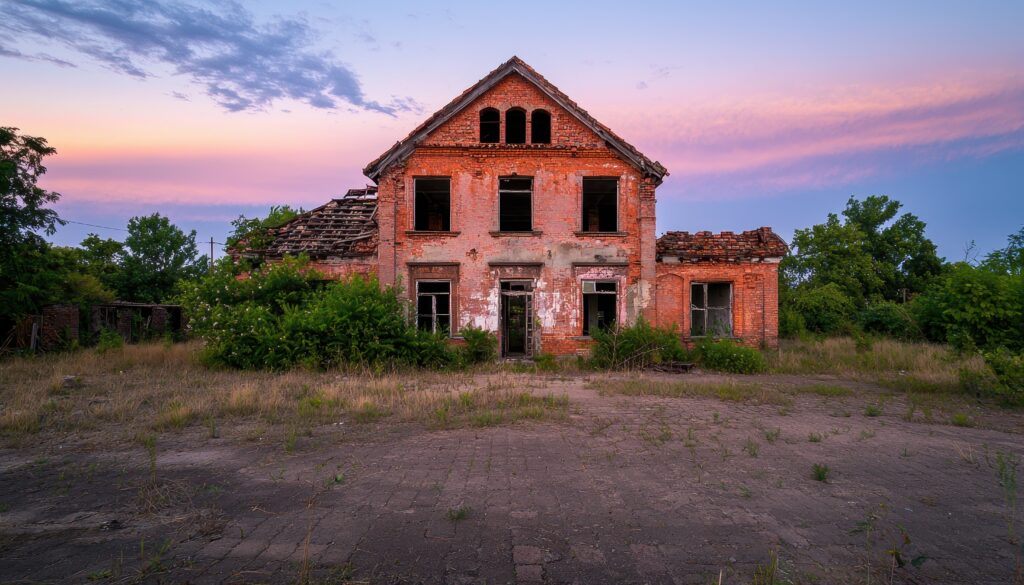
Abandoned Stock photos by Vecteezy
Vacant Properties rarely decline all at once. More often, they deteriorate quietly-through small, compounding change that go unnoticed when a building is unoccupied and unmanaged. The absence of activity can create the impression that nothing is happening, when in reality conditions are steadily shifting.
When preservation is deferred, time becomes an active force. Weather, moisture, temperature changes and lack of oversight begin to affect a property long before visible damage appears. These early changes are easy to dismiss because they do not feel urgent, but they shape outcomes well before decisions are forced.
In many cases, the issue is not neglect in the traditional sense. Owners may intend to return, renovate, or sell at a later date. Preservation is postponed in favor of future plans. What’s often underestimated is how quickly optionality erodes when a property is left without stabilization or routine attention.
This article examines what happens when vacant properties are not preserved-not as a cautionary tale, but as a practical explanation of cause and effect. Understanding these patterns clarifies why preservation functions less as a maintenance task and more as a form of risk management during periods of inactivity. Vacancy does not cause deterioration it simply makes it less visible.
Vacancy Doesn’t Cause Deterioration
Vacancy does not place a property in stasis. Even when a building is unoccupied physical and environmental forces continue to act on it. Without regular use or oversight, small changes occur quietly and without interruption.
Weather exposure is one of the most consistent contributors. Temperature fluctuations cause materials to expand and contract. Moisture finds pathways through minor openings. Drainage systems clog when not monitored. These changes are rarely visible at first, which makes them easy to dismiss.
In occupied properties, daily activity often reveals early warning signs. A leak is noticed because someone hears it. A draft is felt because a space is being used. In a vacant property, these signals go unobserved. Issues are allowed to progress uninterrupted, not because they are severe, but because there is no feedback loop.
Pests and vegetation also take advantage of inactivity. Small access points that would normally be addressed remain open. Over time, their presence introduces secondary damage that compounds the original issue. What began as a minor condition become more complex simply because no one was watching.
The key distinction is not the presence of damage, but the absence of detection. Vacancy removes the mechanisms that surface problems early. Preservation exists to replace that loss of oversight. Without it, deterioration continues-not dramatically, but consistently. When early changes go unnoticed, they rarely remain contained.
Small Issues Become Structural Ones
Most structural problems do not begin as structural. They begin as minor conditions that remain unresolved long enough to change the surroundings systems. In vacant properties, this progression is accelerated by time and the absence of intervention.
A small roof breach, for example, may allow moisture to enter intermittently. At first the impact is localized and largely invisible. Over time, repeated exposure affects insulation, framing and interior finishes. What could have been addressed early becomes embedded in the structure because no one was present to interrupt the cycle.
Similar pattens occur with exterior elements. Deferred gutter maintenance lead to improper drainage. Water is redirected towards foundations or walls not designed to manage it. Seasonal expansion and contraction stress material already weakened by moisture. Each stage builds on the last, not because conditions are extreme, but because they persist.
Access- related issues follow the same logic. An unsecured opening invites intrusion, whether from weather, animals or people. Once access is compromised, secondary damage becomes more likely. Interior systems that were previously protected are exposed, and deterioration accelerates beyond the original point of failure.
The transition from minor issues to structural concerns is rarely abrupt. It unfolds gradually, through accumulation rather than impact. Preservation exists to interrupt this progression early before the nature of the problem changes. When that interruption does not occur, recovery becomes more complex not because the property was inherently flawed, but because small issues were allowed to mature unchecked. As physical conditions escalate, the consequence extends beyond the building itself.
Carrying Cost Increase While Options Shrink
As physical conditions deteriorate, the financial profile of a vacant property begins to change as well. Carrying costs do not remain static when preservation is deferred; they tend to rise alongside uncertainty and risk.
Insurance is often the first area affected. Vacant properties already face stricter coverage terms, and visible deterioration can trigger exclusions, premium increases, or coverage terms, and visible deterioration can trigger exclusions, premium increases or coverage challenges altogether. What was once a manageable holding expense becomes a point of friction that limits flexibility.
Municipal exposure can also increase. Deferred exterior maintenance, unsecured access, or visible neglect may result in notices, fines, or complications requirements. These interventions rarely improve the property; they simply add urgency and cost to an already constrained situation.
At the same time, repair scope expands. As minor issues evolve into more complex conditions, the resources required to stabilize the property grow. Capital that could have supported strategic improvement is redirected toward recovery, narrowing the range of viable next steps.
This convergence-higher cost and fewer options-creates pressure. Decisions that could have been made deliberately are now made reactively. Timelines compress, and outcomes are shaped less by strategy than by necessity. This property has not only lost condition; it has lost optionality.
Preservation exists to slow this process. By stabilizing conditions early, carrying costs remain more predictable and decisions remain voluntary. When preservation is absent, the financial and strategic consequences tend to arrive together, leaving fewer paths forward. As costs rise and flexibility diminish, a common misunderstanding often emerges.
Preservation is Often Confused with Improvement
One reason preservation is deferred is that it is frequently misunderstood. Preservation is often conflated with renovation or improvement, leading owners to delay action until they are ready to “do the work properly.” In the meantime, the property remains exposed.
Improvement focuses on enhancement-adding features, upgrading systems, or changing appearance. Preservation, by contrast, is concerned with stabilization. Its purpose is not to make a property better, but to prevent it from becoming worse. This distinction matters during vacancy, when inactivity can quietly undermine future plans.
Because preservation does not produce visible transformations, it can feel unsatisfying. There is no immediate payoff and little outward progress to point to. As a result, it is sometimes viewed as optional or temporary, something to address later when improvement begins. This framing misses its role entirely.
Preservation functions as a holding strategy. It maintains baseline conditions so that future decisions-whether to improve, sell, or reposition-can be made without the pressure of deterioration. When preservation is postponed in anticipation of improvement, the property continues to change, often in ways that complicate or constrain those later decisions.
Understanding preservation as distinct from improvement clarifies why timing matters. Preservation is most effective when it occurs early, during periods of inactivity. Waiting until improvement begins does not recover what was lost in the interim; it simply addresses a more advanced problem. When preservation is delayed long enough, inaction itself begins to shape outcomes.
When Inaction Force Decisions
When a vacant property is left without preservation, inaction does not preserve flexibility. Instead, it begins to dictate outcomes. As conditions change and costs accumulate, decisions that were once optional become unavoidable.
Physical deterioration introduces urgency. What could have been addressed on a planned timeline now demands immediate attention. Financial pressure compounds this urgency as carrying costs rise and exposure increases. The result is a narrowing window in which decisions must be made, often with incomplete information and limited alternatives.
In this environment, strategy gives way to reaction. Owners may feel compelled to sell sooner than intended, defer necessary work indefinitely, or commit capital under less favorable conditions simply to regain stability. These decisions are not the results of poor planning; they are the consequence of delayed stabilization.
Inaction also alters leverage, shifting control away from the owner and toward external constraints- a dynamic that reflects the importance of process and discipline over reactive decision-making. As a property’s condition worsens, negotiating positions weaken. Buyers, insurers, lenders and municipalities respond to visible risks. Options that once existed quietly disappear, replaced by requirements and constraints imposed from the outside.
Preservation exists to prevent this shift. By maintaining baseline conditions preservation keep decision voluntary rather than forced. It allows owners to act from intention instead of urgency. When preservation is absent, the property continues to change, and those changes increasingly determine the terms under which decisions are made. The cost of this pressure is not just financial; it reshapes how resources are ultimately used.
Why Early Preservation Is Cheaper Thank Recovery
Early preservation is not about minimizing expense; it is about controlling scope. When baseline conditions are maintained, issues remain contained and predictable. Intervention is limited to stabilization rather than correction, and resources are applied deliberately instead of reactively.
Recovery, by contrast, absorbs uncertainty. Once deterioration advances, multiple systems are often affected at once. Addressing one issue expose another. Costs rise not because materials or labor are inherently more expensive, but because problems have compounded beyond their original boundaries.
Preservation limits this escalation by interrupting deterioration early. Moisture is managed before it spreads. Access is secured before intrusion occurs. Exterior elements are maintained before that redirect stress to interior systems. Each small action prevents a larger chain reaction from forming.
There is also a difference in timing. Preservation can be scheduled and paced. Recovery is often urgent. When conditions worsen to the point of requiring immediate action, decisions are made under pressure, and tradeoffs become less favorable. Resources are consumed simply to restore stability, not to advance a strategy.
Viewed this way, preservation is not a cost-saving measure in isolation. It is a cost-shaping one. It keeps future work proportional to the original issue rather than to the accumulated effects of delay. When preservation is deferred, recovery becomes unavoidable-and recovery rarely occurs on ideal terms.
Conclusion
Vacant properties rarely fail because of a single event. More often, they decline through small, uninterrupted change, quietly reshaping both the physical condition of a property and the decisions available to those responsible for it.
Preservation functions are a form of stewardship during periods of inactivity. It does not create momentum or improvement, but it maintains stability and protects optionality. By addressing early exposure and replacing lost oversight, preservation keeps future decisions intentional rather than reactive.
Understanding what happens when vacant properties are not preserved clarifies the role preservation is meant to play. It is not a response to crisis nor a substitute for improvement. It is a disciplined approach to holding risk in check while time passes.
In this context, preservation is less about maintenance and more about responsibility. It acknowledges that vacancy is not neutral and that inaction carries consequences. When preservation is treated as an integral part of property management, value is easier to protect and far harder to lose. Real estate value is created through a sequence of disciplined decisions, not a single transaction. This broader framework is explored in From Vacant to Valuable: How Real Estate Value is Created in Distressed and Vacant Properties. Preservation doesn’t promise upside. It prevents avoidable loss.